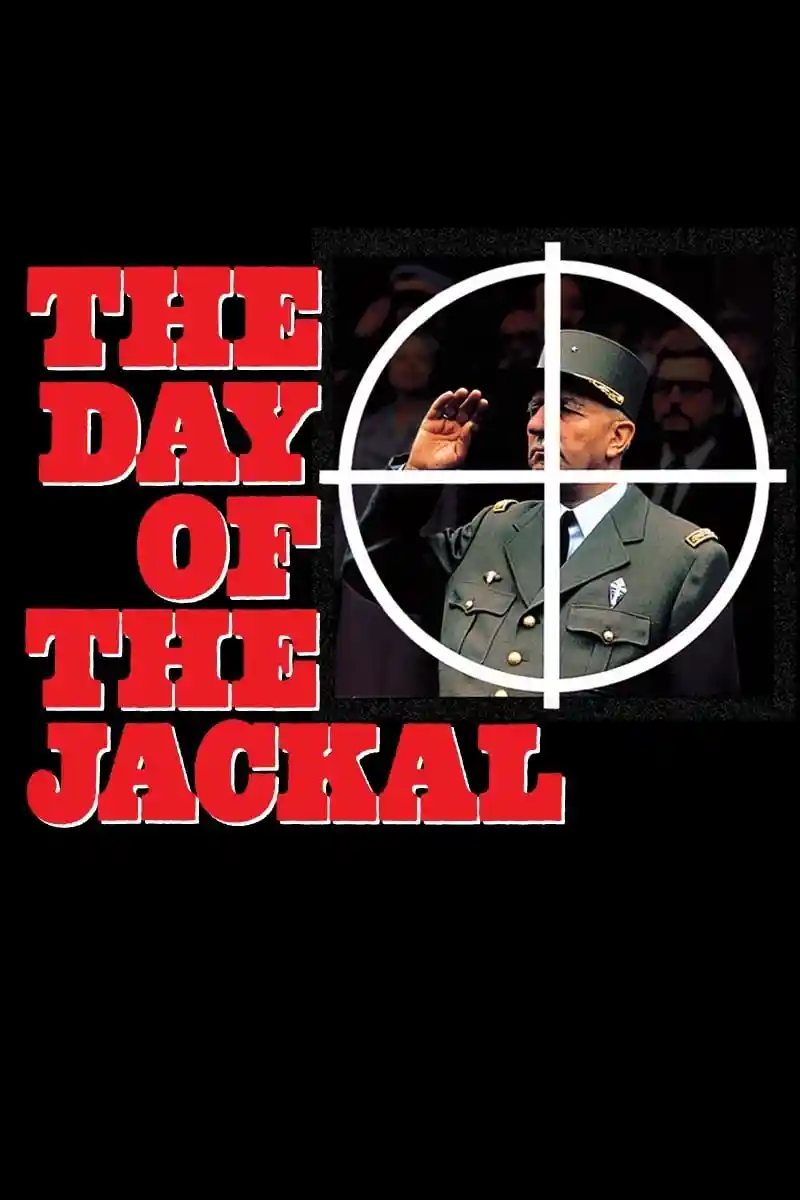
The Day of the Jackal (1973): The Procedural Thriller That Defined the Genre
Fred Zinnemann's meticulous assassination thriller follows a killer we know will fail—and makes it unbearably tense anyway. The blueprint for every procedural that followed.
Here’s the challenge Fred Zinnemann set himself in 1973: make a thriller about an assassination attempt that the audience knows will fail. Charles de Gaulle wasn’t killed by a sniper in the 1960s. History tells us the Jackal doesn’t succeed. So why should we care?
By the end of The Day of the Jackal, you’ll be on the edge of your seat watching a man we know won’t hit his target. That’s the magic of this film—it proves that tension comes from execution, not outcome.
The Dual Structure
The film follows two parallel tracks that slowly converge:
The Jackal (Edward Fox): A professional assassin hired by the OAS—a French paramilitary group angry about Algerian independence—to kill President de Gaulle. We watch him plan: forging identities, acquiring weapons, testing his custom-made rifle, establishing escape routes.
Lebel (Michael Lonsdale): A French police detective assigned to find and stop the assassin. He starts with nothing—not even knowing the killer’s nationality—and builds his investigation through patient, methodical police work.
Neither story is more important than the other. Zinnemann cuts between them, building two kinds of competence: the competence of the hunter and the hunted.
The Procedure Is the Plot
What makes The Day of the Jackal revolutionary is its commitment to process. We watch the Jackal:
- Meet with a forger to create French identity documents
- Commission a custom rifle that disassembles into innocent-looking parts
- Test the rifle on a watermelon painted like a head
- Create multiple backup identities
- Scout escape routes across France
We watch Lebel:
- Interview the one surviving witness who’s seen the Jackal’s face
- Coordinate with international police agencies
- Track down the forger’s body
- Cross-reference missing persons reports
- Set up checkpoints across the country
| Jackal’s Progress | Lebel’s Progress |
|---|---|
| Forges identity | Finds forger’s body |
| Crosses into France | Establishes checkpoint network |
| Acquires disguises | Circulates description |
| Reaches Paris | Narrows search to Paris |
| Gets to position | Realizes the parade is the target |
Each step is shown in detail. There are no shortcuts, no “movie logic” jumps. The pleasure is in watching professionals work.
Edward Fox: The Perfect Killer
Fox’s Jackal is a remarkable creation: charming when necessary, cold when efficient, entirely without psychology. We never learn his real name. We never learn why he kills for money. We never get a backstory or a motivation beyond professionalism.
This blankness is the point. The Jackal is a function, not a character. Fox plays him with the precision of a surgeon—every movement economical, every emotion controlled. When he kills (and he does kill, when obstacles appear), there’s no pleasure in it. It’s simply problem-solving.
The famous scene where he tests his rifle on a watermelon tells you everything: he watches the melon explode, nods with satisfaction at the ballistic performance, and moves on. The violence is technical. The killing is work.
Michael Lonsdale: The Rumpled Detective
Against the Jackal’s elegance, Lonsdale’s Lebel is deliberately ordinary. He’s not a brilliant maverick detective. He’s not handsome or dynamic. He works slowly, follows procedure, coordinates with bureaucracies.
But he’s tenacious. And he’s patient. And when he finally corners the Jackal, it’s not through genius—it’s through the accumulated weight of good police work.
Lonsdale plays Lebel as a man who knows his limitations and works within them. There’s something almost heroic in his ordinariness.
Zinnemann’s Rigor
Fred Zinnemann was one of Hollywood’s master craftsmen, and The Day of the Jackal represents his style at its purest: no flash, no unnecessary style, complete confidence in the material.
The film runs 143 minutes, and none of it is wasted. Every scene advances the parallel investigations. Every location is specific and real. Zinnemann shot on location across France and England, giving the film a documentary authenticity that studio work couldn’t match.
His direction is invisible in the best sense—you’re never aware of a camera, a cut, a directorial choice. You’re simply watching events unfold with the clarity of observed reality.
The Ending: Known and Still Tense
⚠️ Spoiler Warning: Discussion of the ending follows.
The final sequence is masterfully constructed. De Gaulle is at a ceremony. The Jackal is in position—a room overlooking the parade route. Lebel is racing to find him.
We know the Jackal will fail. We know de Gaulle will live. History has already written this ending.
And yet: when Lebel bursts into the room, when the Jackal turns, when the shot is fired—the tension is genuine. Zinnemann has made us forget what we know through sheer technique.
The Jackal dies anonymously. His body is buried in an unmarked grave. No one knows who he was. The final title card tells us this—and the mystery remains. The professional disappears without a trace.
The Procedural Legacy
Every procedural thriller since 1973 owes something to The Day of the Jackal. The patient accumulation of detail. The parallel structure of hunter and hunted. The focus on how rather than why.
You can see its influence in:
- Munich (2005) — Spielberg’s assassination procedural
- Zodiac (2007) — Fincher’s obsessive investigation
- Zero Dark Thirty (2012) — Bigelow’s intelligence-gathering epic
- Tinker Tailor Soldier Spy (2011) — Another spy procedural with similar rigor
These films work because The Day of the Jackal proved that procedure itself could be dramatic. You don’t need explosions. You need competence, stakes, and time.
My Rating: 9/10
What works:
- Fox and Lonsdale are perfect opposites
- The procedural detail is fascinating, not tedious
- Builds tension despite known outcome
- Zinnemann’s direction is masterfully invisible
- The ending satisfies despite being predetermined
What doesn’t:
- 143 minutes requires patience
- No emotional arc for any character
- Some 1970s elements feel dated
If You Liked This, Try:
- Three Days of the Condor (1975) — Political thriller with similar paranoid energy
- All the President’s Men (1976) — Procedural journalism
- Munich (2005) — Spielberg’s spiritual successor
- Zodiac (2007) — Investigative procedural with similar obsessiveness
- No Country for Old Men (2007) — Another unstoppable professional
The Day of the Jackal proves that knowing the ending doesn’t eliminate suspense—it transforms it. We watch not to see if the Jackal succeeds but to see how close he gets, how many obstacles he overcomes, how nearly history might have been different.
That “nearly” is the whole film. And it’s enough.
References
- Forsyth, Frederick. The Day of the Jackal (novel), Viking Press, 1971
- Zinnemann, Fred. An Autobiography, Bloomsbury, 1992
- Ebert, Roger. Review, Chicago Sun-Times, 1973
- Canby, Vincent. Review, New York Times, 1973
- British Film Institute. “The Day of the Jackal” restoration notes