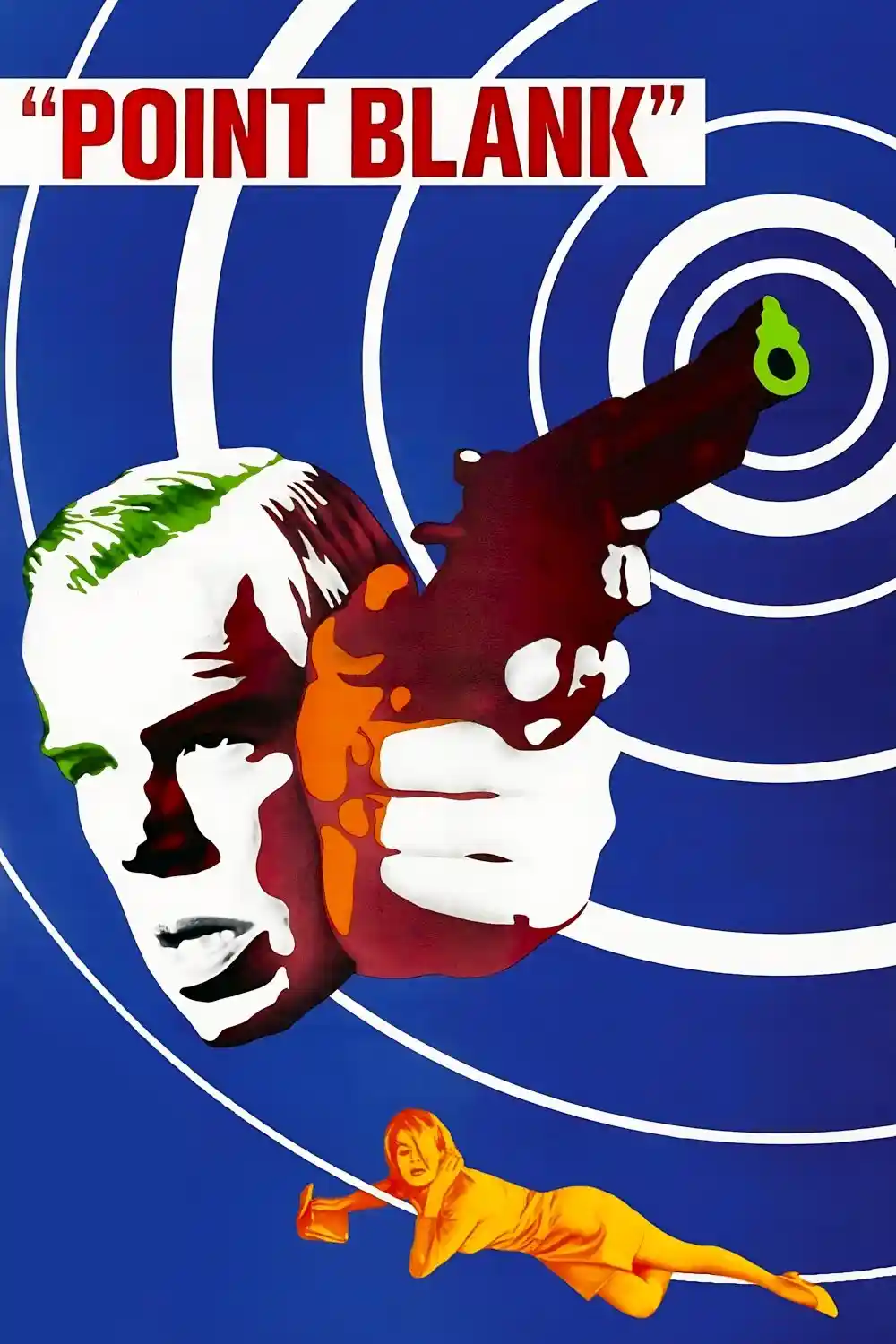
Point Blank (1967): How John Boorman Turned Revenge Into Abstract Art
Lee Marvin stalks through a neon nightmare of corporate crime in John Boorman's revolutionary neo-noir. A film that deconstructed the revenge thriller before the genre knew what hit it.
The first time I watched Point Blank, I didn’t understand it. The second time, I thought I understood it. The third time, I realized understanding might not be the point.
John Boorman’s 1967 revenge thriller is one of those rare films that seems to operate on multiple frequencies simultaneously. On one level, it’s a straightforward crime movie: Lee Marvin plays Walker, a man betrayed by his wife and best friend during a heist, left for dead in the abandoned Alcatraz prison, who somehow survives and methodically hunts down everyone responsible. On another level, it’s something else entirely—a fever dream, a ghost story, a meditation on the impossibility of satisfaction in a world where crime has been corporatized.
Pauline Kael, reviewing Bonnie and Clyde that same year, called Point Blank “intermittently dazzling.” She was being too cautious. This film isn’t intermittent about anything. It’s relentlessly, aggressively itself from the first frame to the last.
Walker: The Man Who Might Be Dead
Let’s start with the elephant in the room—or rather, the ghost in the machine. There’s a reading of Point Blank that suggests Walker actually died in that cell on Alcatraz, and everything we see afterward is his dying fantasy of revenge.
Boorman has never confirmed this interpretation, but he’s never denied it either. And the film gives you plenty of evidence:
- Walker’s gunshot wounds should be fatal, yet he survives without medical treatment
- He never eats, sleeps, or shows any physical vulnerability
- He walks through the film like a force of nature, not a human being
- The ending leaves him standing alone in darkness, refusing to emerge
But here’s what I find more interesting than the “is he dead?” question: it doesn’t matter. Whether Walker is alive or dead, he functions the same way in the film—as an unstoppable vector of consequence, a bullet that was fired in that Alcatraz cell and simply hasn’t stopped moving yet.
Lee Marvin understood this. Watch how he plays Walker: there’s no interiority. No psychology. When Walker wants his money—his share of the heist, $93,000—he says so. When people try to negotiate, explain, or reason with him, he just repeats his demand. He’s not a character having an arc. He’s an irresistible force encountering movable objects.
The Sound of Footsteps
I have to talk about the opening sequence because it contains some of the most audacious filmmaking of the 1960s.
Walker walks through the LA airport. We hear his footsteps echoing—hard, relentless, mechanical. These footsteps continue over a series of flashback fragments: the heist, the betrayal, the shooting, his escape. The sound design refuses to let you orient yourself temporally. Past and present collapse into each other.
| Time Period | Visual | Audio |
|---|---|---|
| Present | Walker in airport | Continuous footsteps |
| Past | Heist planning | Same footsteps (non-diegetic) |
| Past | Betrayal shooting | Footsteps merge with gunshots |
| Past | Walker in Alcatraz cell | Footsteps suggest escape |
| Present | Walker arriving at wife’s apartment | Footsteps finally synced |
This isn’t just stylish—it’s philosophical. Boorman is telling you that Walker exists outside normal time. His revenge isn’t something that will happen; it’s something that’s always already happening. The betrayal and the retaliation are simultaneous, eternally recurring.
When those footsteps finally stop, when Walker kicks in his wife’s door and finds her dead (overdose, possibly suicide), the silence is shattering. For a moment, you think he might actually feel something. Then he empties his gun into the bed where she should have been sleeping.
Walker isn’t processing grief. He’s completing a trajectory.
Los Angeles as Nightmare Architecture
Boorman shot Point Blank primarily in Los Angeles, but it’s not any LA you’d recognize from other 1960s films. This isn’t The Graduate’s sun-drenched suburbia or Chinatown’s sepia-toned nostalgia. This is LA as concrete void, all corporate high-rises and soulless infrastructure.
The cinematographer Philip H. Lathrop deserves enormous credit for the visual scheme. Watch how color works in this film:
Early scenes: Washed out, almost monochromatic. The Alcatraz flashbacks are gray and blue, cold as a morgue.
LA sequences: Harsh, artificial colors. When Walker walks through that apartment complex to find Angie Dickinson’s Chris, everything is aggressively modern—orange shag carpet, geometrically impossible furniture, glass and chrome everywhere.
Corporate offices: Sterile white. The higher Walker climbs in the criminal organization, the more the spaces look like legitimate businesses. By the time he reaches the upper management, the mob is indistinguishable from any other corporation.
This was Boorman’s insight, and it was ahead of its time: crime in America had become corporate. There’s no Big Boss to kill, no final confrontation with evil incarnate. There’s just a org chart, a chain of command, people who claim they don’t have the authority to get Walker his money.
The Violence Problem (And Solution)
For a revenge movie, Point Blank has surprisingly little direct violence from its protagonist. Walker doesn’t shoot many people. He pushes them, slaps them, throws them around. His most memorable “kills” aren’t kills at all—he manipulates situations so that his enemies destroy each other.
This is clever from a Production Code standpoint (the Code was still technically in effect, though rapidly eroding), but it’s also thematically perfect. Walker isn’t interested in violence as catharsis. He’s interested in getting what he’s owed. Violence is just a tool, and often not the most efficient one.
The one scene of genuine brutality—Walker forcing information out of a car dealer by slamming his head into things—plays almost comedically. The man keeps offering Walker information he already has, and Walker keeps hitting him anyway. It’s absurdist violence, violence as communication breakdown.
Compare this to the film’s actual shocking moment: when Walker uses Angie Dickinson’s Chris as bait for Reese (John Vernon). Chris ends up in a brutally one-sided confrontation that Walker set up and watches impassively. This isn’t heroic revenge. This is cold instrumentality.
Angie Dickinson and the Problem of Women in Noir
Let me be direct: Point Blank has a complicated relationship with its female characters. Both of the main women—Lynne (Sharon Acker), Walker’s wife, and Chris (Angie Dickinson), her sister—are positioned entirely in relation to Walker’s journey. Neither has independent agency or goals.
But within those limitations, Dickinson does something remarkable. Her character could be pure femme fatale, the duplicitous woman who might betray our hero. Instead, she plays Chris as someone genuinely damaged, traumatized by her proximity to violent men, trying to maintain some core of self.
The scene where she attacks Walker, hitting him again and again while he stands motionless, is often read as comic or erotic. I read it as something else: a woman’s rage at being used, at being a piece in someone else’s game, finally expressed physically. Walker absorbs it not because he’s tough, but because he’s absent. There’s nothing there to hit.
When Chris finally asks, “What’s my part?” and Walker replies “Just tell him where I am”—reducing her explicitly to bait—her expression isn’t resignation. It’s recognition. She knows exactly what she’s dealing with now.
The Ending: Nothing for Nobody
⚠️ Spoiler Warning: Full discussion of the ending follows.
The climax of Point Blank takes place at the same location where it began: Alcatraz. The setup for a final confrontation is perfect. The money is there. The remaining villain is there. Walker is there.
And then… Walker doesn’t show.
We see him in the shadows. We expect him to emerge, claim his prize, complete his arc. Instead, he fades back into darkness. The money sits unclaimed. The film ends.
What the hell?
Here’s my reading: Walker can’t take the money because taking it would mean stopping. His entire existence since Alcatraz has been movement, pursuit, trajectory. The money isn’t actually what he wants—it’s never been what he wants. He wants the impossible: to undo the betrayal, to go back to before, to be the man who wasn’t shot by his best friend.
You can’t have that. So Walker doesn’t take anything. He returns to the darkness of the abandoned prison, which may be where he’s been all along.
Or maybe I’m overthinking it. Maybe he just doesn’t trust the setup. That’s the beauty of the film—it supports both readings.
Influence: The Next Fifty Years
The fingerprints of Point Blank are everywhere in subsequent cinema:
- Payback (1999): The Mel Gibson film is a direct adaptation of the same Donald E. Westlake novel (The Hunter), but it misses what Boorman understood—the abstraction is the point
- Drive (2011): Nicolas Winding Refn’s neon crime dream shares DNA with Boorman’s approach to violence and silence
- John Wick (2014-): Another unstoppable force pursuing organization criminals, though played for different emotional registers
- Heat (1995): Michael Mann’s LA is recognizably descended from Boorman’s corporate wasteland
But none of these films quite capture what makes Point Blank singular: its willingness to make the protagonist a void, a negative space, a question mark that never resolves into an answer.
Technical Excellence
A few specific craft elements worth noting:
Editing: The non-linear opening establishes a rhythm that the film maintains throughout—cutting not for continuity but for psychological effect. Walker’s flashbacks intrude on present action, suggesting he can’t escape his own past.
Sound: Beyond the famous footsteps, the film uses silence powerfully. Scenes that “should” have score don’t. The effect is alienating in the best way.
Set design: Every space Walker enters tells you something about its occupants. The hollow modernism of LA, the industrial decay of Alcatraz, the sterile corporate offices—they’re all prisons of different kinds.
Pacing: The film runs 92 minutes and not a frame is wasted. Modern audiences used to bloated runtimes might find it shockingly efficient.
My Rating: 9.5/10
What works:
- Marvin’s performance is iconic—all surface, all depth
- Boorman’s direction is audacious and assured
- The LA locations are used brilliantly
- Rewards multiple viewings with new details
- Ending is perfectly ambiguous
What doesn’t:
- Gender politics are firmly of their era
- Some viewers find the abstraction alienating
- The studio-mandated Angie Dickinson romance feels grafted on
If You Liked This, Try:
- Le Samourai (1967) — Alain Delon as another silent, possibly supernatural avenger
- The Limey (1999) — Steven Soderbergh’s similarly fractured revenge tale
- Get Carter (1971) — British noir with Michael Caine in a Walker-adjacent role
- Ghost Dog (1999) — Jim Jarmusch’s meditation on the samurai code and obsolescence
Point Blank is the rare film that becomes more modern as it ages. In 1967, its formal experimentation seemed avant-garde, its corporate critique felt theoretical. Now, watching a man demand his money from an organization that keeps insisting nobody has the authority to help him, it feels like documentary realism.
Walker is still walking through that airport. His footsteps are still echoing. The money is still sitting there unclaimed. And we’re all still trying to figure out if he ever made it off that island.
References
- Kael, Pauline. “Bonnie and Clyde,” The New Yorker, October 1967
- Boorman, John. Adventures of a Suburban Boy (memoir), Faber & Faber, 2003
- Westlake, Donald E. (as Richard Stark). The Hunter, Pocket Books, 1962
- “A Man Out of Time: John Boorman and Lee Marvin’s Point Blank,” Senses of Cinema, 2007
- Variety staff. Original review, 1967
- Thompson, David. “John Boorman: Primal Visions,” Sight & Sound, 2002