Scream 7 Breaks Franchise Records with $64.1M Opening, Pushes Series Past $1 Billion Milestone
Kevin Williamson's Scream 7 delivers the franchise's biggest opening weekend ever with $64.1M domestically, propelling the horror series past $1 billion globally.
Scream 7 Breaks Franchise Records with $64.1M Opening, Pushes Series Past $1 Billion Milestone
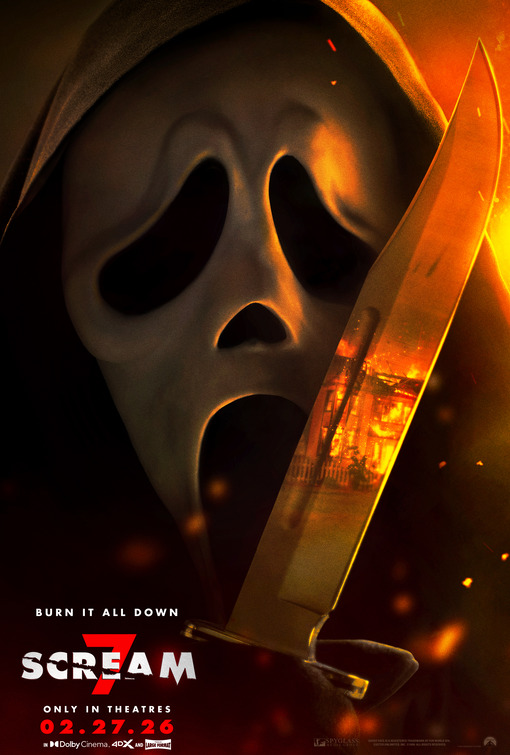
Ghostface just had its biggest opening ever. Scream 7, the latest installment in Paramount Pictures and Spyglass Media Group’s long-running slasher franchise, shattered series records with a $64.1 million domestic opening weekend—the biggest debut in the franchise’s 30-year history.
The film, which opened in 3,540 theaters on February 27, 2026, also earned $33.1 million across 52 international markets, bringing its worldwide opening weekend total to $97.2 million. This performance not only eclipses the previous franchise record set by 2023’s Scream VI ($44.5 million domestic opening) but also propels the entire Scream series past the $1 billion mark in global box office earnings.
Record-Breaking Numbers
With a per-theater average of $18,107, Scream 7 pulled strong numbers despite mixed critical reception. The film’s $64.1 million domestic debut represents a 44% increase over Scream VI’s opening and nearly doubles the $34.7 million opening weekend of 2000’s Scream 3, which previously held the franchise’s opening weekend record for over two decades.
The seventh installment was produced on a lean $45 million budget, making its opening weekend especially profitable. Industry analysts had initially projected a $50-60 million debut, but strong audience turnout exceeded expectations by approximately 20%.
International markets showed robust support, with the UK and Ireland leading the charge at $5.3 million—28% above Scream VI’s performance in those territories. France contributed $4.2 million, followed by Mexico ($3.0 million), Australia ($2.5 million), Germany ($2.4 million), Brazil ($2.3 million), Italy ($1.8 million), and Spain ($1.4 million). The film topped the weekend box office in all these markets except France, where a local hit continued to dominate.
Franchise History and Context
To fully appreciate Scream 7’s achievement, it’s essential to examine the franchise’s box office trajectory over three decades. The original Scream, directed by the late Wes Craven and written by Kevin Williamson, opened in December 1996 to a modest $6.4 million from 1,413 theaters. Through strong word-of-mouth and cultural impact, it ultimately grossed $103 million domestically and $173 million worldwide, becoming the highest-grossing slasher film of its era.
Scream 2 (1997) capitalized on the original’s success with a $32.9 million opening, finishing with $101.3 million domestically and $172 million globally. Scream 3 (2000) opened to $34.7 million and earned $89.1 million domestically ($161 million worldwide). After an 11-year hiatus, Scream 4 (2011) struggled with $18.7 million opening and $38.1 million domestic total ($97 million worldwide), leading many to believe the franchise had run its course.
The series was revived in 2022 with a fifth installment (also titled Scream), directed by Matt Bettinelli-Olpin and Tyler Gillett. It opened to $30 million and finished with $81.6 million domestically ($138 million worldwide). Scream VI (2023) improved further with a $44.5 million opening and $108.4 million domestic total ($166.6 million worldwide), setting the stage for Scream 7’s record-breaking performance.
The Billion-Dollar Club
With Scream 7’s strong debut pushing the franchise’s cumulative global box office past $1.009 billion, the series has joined an elite group of horror franchises to achieve this milestone. Only five other horror franchises have crossed the billion-dollar threshold:
- The Conjuring Universe - Nearly $2.9 billion (the highest-grossing horror franchise)
- Alien - Over $1.6 billion
- Resident Evil - Approximately $1.2 billion
- It - Over $1.1 billion
- Saw - Approximately $1.05 billion
This is notable for a horror franchise, which typically has lower production budgets and more limited international appeal than action blockbusters or superhero franchises. The Scream series’ ability to maintain relevance and commercial viability across three decades speaks to the enduring appeal of its meta-horror approach and the iconic status of the Ghostface killer.
Box office analyst FranchiseRe noted that Scream 7’s opening represents a record for a seventh installment in a horror franchise. By comparison, the seventh Alien film (Prometheus, 2012) opened to $51 million, which translates to $72.3 million when adjusted for inflation—higher in real terms but lower in raw numbers.
Critical Reception vs. Audience Response
Scream 7 has generated significant controversy in the critical community, currently holding a 31% rating on Rotten Tomatoes—the lowest in franchise history and well below the “Fresh” threshold. Some sources initially reported a 47% score, but the consensus has settled around the lower figure as more reviews were published.
Critics have been harsh in their assessments. The Hollywood Reporter described “a rote quality to the proceedings that makes Scream 7 feel like a slog despite its high body count.” Variety’s Owen Gleiberman wrote that “Williamson has gone back to basics, but the result is a ‘Scream’ sequel that, while it nods in the direction of being seductively convoluted, is really just…basic.”
The New York Times’ Manohla Dargis offered a measured critique, noting that while the film fulfills “the usual franchise duties by cracking wise, arousing suspicion and dying in an elaborately lurid fashion,” it lacks the innovative spark that defined earlier entries.
However, audience response tells a dramatically different story. The film holds a 76-77% audience score on Rotten Tomatoes, with viewers praising the return to form, the creative kills, and the emotional weight of Neve Campbell’s return as Sidney Prescott. Mashable’s review captured this sentiment, stating that “Williamson smartly surveyed the whole of the franchise, working in lore—and even fan theories—where appropriate… He has delivered wild kills, a meta monologue about horror conventions, and enough comic relief to make this sequel a devilish roller coaster ride.”
EntTelligence reported that approximately 4.2 million people attended Scream 7 during its opening weekend, with a 2D-3D breakdown of 85%-15% and a standard-premium format split of 65%-35% (compared to 78%-22% for Scream VI). The increased premium format uptake suggests audiences were willing to pay more for enhanced viewing experiences.
Kevin Williamson’s Return
Scream 7 marks a significant milestone for Kevin Williamson, who created the franchise 30 years ago but had never directed one of the films. After the controversial departures of stars Melissa Barrera (fired) and Jenna Ortega (who left the project), Paramount and Spyglass handed the reins back to Williamson in an effort to stabilize the production and reassure fans.
Williamson directed from a screenplay he co-wrote with Guy Busick, based on a story by James Vanderbilt and Busick. His approach was to return the franchise to its roots, bringing back Neve Campbell as Sidney Prescott after she sat out Scream VI due to salary disputes. The film also features Courteney Cox reprising her role as Gale Weathers, along with appearances from franchise veterans Matthew Lillard and David Arquette.
The plot centers on Sidney, now living far from Woodsboro with her husband (Joel McHale) and three daughters, including teenager Isabel May. When a new Ghostface killer emerges, Sidney’s family becomes the target, forcing her to confront her darkest fears once again.
Williamson’s direction has been praised by fans for its understanding of what makes Scream work—the balance of horror, humor, and meta-commentary—even as critics found it too familiar. The film reportedly features an alternate ending involving the return of Stu Macher (Matthew Lillard’s character from the original), though this was ultimately not used in the theatrical release.
Implications for the Horror Genre
Scream 7’s success matters for the horror genre and franchise filmmaking. First, it demonstrates that legacy characters and original creators still hold considerable appeal for audiences, even when critics are skeptical. The film’s performance suggests that nostalgia, when executed with care and respect for the source material, can be a powerful commercial force.
Second, the stark divide between critical and audience reception raises questions about the evolving relationship between professional film criticism and popular taste. While critics may desire innovation and fresh approaches, audiences often value emotional satisfaction and franchise continuity. Scream 7’s box office success despite poor reviews indicates that word-of-mouth and fan enthusiasm can overcome negative critical consensus in the social media age.
Third, the film’s achievement in pushing the franchise past $1 billion validates Paramount’s strategy of reviving dormant horror properties. Following the success of the rebooted Scream trilogy (films 5-7), other studios are likely to examine their horror catalogs for similar opportunities.
The horror genre has proven remarkably resilient at the box office, with lower production costs and dedicated fan bases providing consistent returns. Scream 7’s $45 million budget and $97.2 million opening weekend represent the kind of risk-reward ratio that studios find increasingly attractive in an era of rising production costs and uncertain theatrical attendance.
Box Office Trajectory and Future Prospects
While Scream 7’s opening weekend is historic, the film faces challenges in matching the lifetime totals of earlier installments. Horror films are notoriously front-loaded, with steep second-weekend drops common as the most enthusiastic fans rush to see the film immediately. Scream VI, for example, dropped 59% in its second weekend.
However, Scream 7’s strong audience scores and positive word-of-mouth could lead to better-than-expected legs. The film is currently tracking to potentially surpass Scream VI’s $166.6 million worldwide total and could challenge the original Scream’s $173 million global record, though reaching that milestone would require sustained performance over several weeks.
Comscore reported a $110.8 million three-day weekend across all films, putting year-to-date box office at $1.2 billion, tracking 9.4% ahead of 2025 at the same stage. Scream 7’s contribution to this total represents a significant boost for the industry as it continues to recover and adapt to changing viewing habits.
What’s Next for Ghostface?
With Scream 7’s commercial success, speculation about Scream 8 has already begun. While no official announcement has been made, industry insiders suggest that Paramount and Spyglass are likely to greenlight another installment given the strong box office performance and the franchise’s newfound billion-dollar status.
The question remains whether Kevin Williamson would return to direct, or if the studio would bring back Matt Bettinelli-Olpin and Tyler Gillett, who helmed Scream (2022) and Scream VI. Neve Campbell’s return has been celebrated by fans, and her continued involvement would likely be a priority for any future installments.
The franchise’s ability to reinvent itself while maintaining core elements—the Ghostface mask, the meta-commentary, the whodunit structure—has proven to be its greatest strength. As long as audiences remain engaged with the mystery of who’s behind the mask and the franchise continues to comment on horror conventions and contemporary culture, Ghostface will likely continue stalking theaters for years to come.
Conclusion
Scream 7’s record-breaking $64.1 million domestic opening and $97.2 million worldwide debut are more than box office wins. They’re a cultural moment for a franchise that has defined and redefined slasher cinema for three decades. By pushing the series past the $1 billion milestone and joining horror’s most elite club, Scream 7 has secured its place in genre history.
Whether the film’s critical reception will impact its long-term box office performance remains to be seen, but the opening weekend’s success demonstrates that audiences are still eager to answer the phone when Ghostface calls. In an industry increasingly dominated by superhero franchises and established IP, Scream 7 proves that horror, when executed with passion and respect for its legacy, can still deliver both scares and box office gold.
As Kevin Williamson’s film continues its theatrical run, one thing is certain: reports of the slasher genre’s death have been greatly exaggerated. Ghostface isn’t going anywhere—and neither are the millions of fans who keep coming back for more.