Wuthering Heights (2026): A Modern Gothic Romance
Emerald Fennell's visually stunning but emotionally hollow adaptation of Emily Brontë's classic transforms the Yorkshire moors into a fever dream of maximalist excess.
A bold reimagining of Brontë’s gothic masterpiece
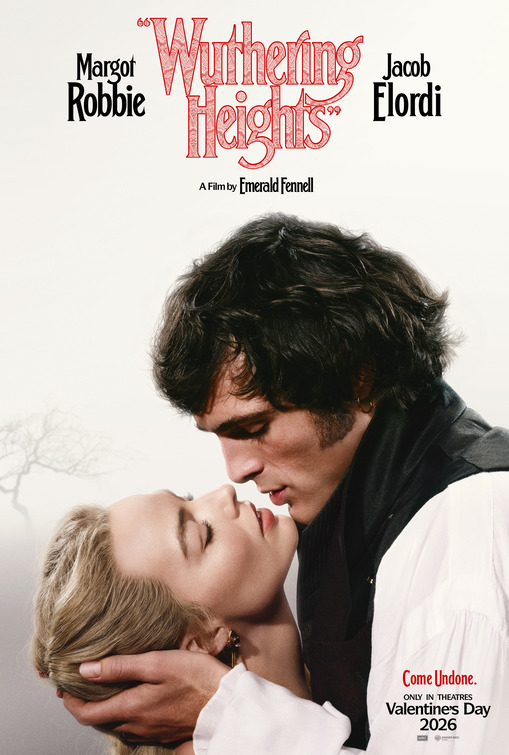
Emerald Fennell’s “Wuthering Heights” arrives in theaters with the weight of nearly two centuries of literary legacy on its shoulders. The Oscar-nominated director of “Promising Young Woman” and “Saltburn” takes Emily Brontë’s 1847 Gothic romance and transforms it into a visually intoxicating, deliberately anachronistic spectacle that prioritizes sensory assault over emotional depth. Released on Valentine’s Day 2026 by Warner Bros., this $80 million production starring Margot Robbie and Jacob Elordi has already sparked fierce debate among critics and audiences alike, grossing over $177 million worldwide while dividing opinion on whether Fennell’s maximalist approach honors or betrays the source material.
Fennell has stated her intention was to “recreate the feeling of a teenage girl reading this book for the first time”—a mission statement that explains both the film’s intoxicating visual excess and its frustrating emotional shallowness. This is “Wuthering Heights” in quotation marks (as the title card literally presents it), a self-aware remix that trades Brontë’s psychological complexity for Instagram-ready imagery and pop-opera melodrama.
Plot and adaptation choices: streamlining the storm
Fennell’s screenplay follows the broad strokes of Brontë’s first volume, focusing on the doomed romance between Catherine Earnshaw (Robbie) and Heathcliff (Elordi). The film opens with a provocative bait-and-switch: what sounds like passionate lovemaking reveals itself to be a public hanging, complete with the condemned man’s erection—a blunt introduction to Fennell’s approach to the novel’s linkage of sex and death.
The narrative traces Catherine and Heathcliff’s childhood bond through their adult passion, Catherine’s marriage to the wealthy Edgar Linton (Shazad Latif), and Heathcliff’s vengeful return. Young actors Owen Cooper and Charlotte Mellington establish the childhood dynamic effectively, but the transition to Robbie and Elordi marks where the film’s emotional architecture begins to crumble.
Fennell makes significant alterations to soften Heathcliff’s cruelty. Gone is much of the character’s sadistic edge; instead, Elordi’s Heathcliff becomes a brooding romantic hero who endures abuse (including a brutal whipping from Catherine’s father) to prove his devotion. His marriage to Isabella Linton (Alison Oliver) is reframed with Isabella as a “smirkingly consenting sub,” draining the relationship of its disturbing power dynamics. These choices transform the story from a tale of mutual destruction into something closer to a bodice-ripper romance novel.
Performances and direction: beauty without chemistry
Margot Robbie delivers a technically proficient performance, capturing Catherine’s capriciousness and yearning with commitment. She walks a tightrope between “infuriating recklessness and devastating regret,” as one critic noted, bringing full-throated energy to every scene. Yet her Catherine feels more like a collection of theatrical gestures than a fully realized character—a “Brontë Barbie” whose emotional journey never quite lands with the devastating impact it should.
Jacob Elordi, whom Fennell wrote the role for after being inspired by his sideburns in “Saltburn,” cuts a striking figure as Heathcliff. With his lavishly hirsute appearance and smoldering intensity, he certainly looks the part of a Gothic romantic hero. However, Fennell’s “fatally shallow characterization” reduces Heathcliff to “pouty man-candy,” a blank slate whose only defining trait is his obsession with Catherine. Elordi’s Yorkshire accent wavers, and despite his considerable screen presence, he’s given little to work with beyond glowering magnetically into the wind.
The central problem plaguing the film is the lack of genuine chemistry between its leads. While some critics praised their “sizzling” connection, many others noted that Robbie and Elordi “have all the chemistry of Barbie and Ken dolls bumping rubber when they collide.” The film includes multiple sex scenes—spanning beds, carriages, and the moors—yet these encounters feel more like fashion editorial spreads than expressions of consuming passion. The iconography is there, but the emotional electricity is not.
The supporting cast fares better. Hong Chau brings subtle menace to Nelly Dean, though the film never fully commits to making her the villain it insists she is. Alison Oliver provides genuinely effective comic relief as Isabella, while Shazad Latif’s Edgar Linton registers as appropriately milquetoast. Martin Clunes and Ewan Mitchell round out the ensemble competently, though they’re largely overshadowed by Fennell’s visual pyrotechnics.
Cinematography and atmosphere: a feast for the eyes
If “Wuthering Heights” succeeds anywhere, it’s in its visual splendor. Cinematographer Linus Sandgren, reuniting with Fennell after “Saltburn,” creates some of the most striking color imagery in recent cinema. Shooting on 35mm film (with VistaVision for wide shots), Sandgren and Fennell had “no limits to how expressive we could be with this love story,” as the cinematographer explained. The result evokes the Technicolor glory of Michael Powell and Emeric Pressburger’s “Black Narcissus” and “A Matter of Life and Death.”
The film’s visual strategy is boldly theatrical, almost feverish. When heartbreak occurs, the sky turns blood red. Thrushcross Grange exists in a state of perpetual spring (except at Christmas, when it always snows). Production designer Suzie Davies created sets with a “wet” aesthetic—walls covered in crystal that appears to sweat and pool on the floor. One room features a floor in such a thick, gaudy shade of red it evokes “The Shining.” Dining tables overflow with jellied extravagances (the film has an unprecedented “aspic ratio,” as one wag noted).
Costume designer Jacqueline Durran’s work is consistently stunning, drawing inspiration from classic Hollywood films like “Gone with the Wind” rather than historical accuracy. Production stills revealed synthetic latex-like dresses, shimmery negligees, and rose-colored glasses that evoke a far more modern feel. The color red seeps into and out of Catherine’s wardrobe like a visual metaphor for passion and blood. Entire essays could be written about Durran’s costume choices alone.
Yet this visual maximalism comes at a cost. The film feels like “a prolonged exercise in watching characters spiral through avoidable chaos,” as one reviewer noted. The aesthetic is so overwhelming that it becomes exhausting, a “full-throated, filthy maximalism” that prioritizes surface over substance. The cinematography is gorgeous, the costumes immaculate, but these elements can’t carry a film whose emotional core remains hollow.
Comparison to source material: quotation marks as warning
The decision to stylize the title as “Wuthering Heights” (with quotation marks) signals Fennell’s postmodern approach, though the irony feels pointless. This is not a faithful adaptation but a radical reinterpretation that uses Brontë’s framework as a launching pad for Fennell’s own obsessions.
Brontë’s novel is a complex, multi-generational narrative told through nested flashbacks, exploring themes of class, race, revenge, and the destructive nature of obsessive love. Heathcliff’s ambiguous racial identity (Brontë describes him as dark-skinned, possibly Romani or of African descent) is central to his outsider status and the abuse he suffers. Fennell’s casting of the white Australian actor Jacob Elordi sparked immediate controversy, erasing this crucial dimension of the character.
The novel’s Heathcliff is genuinely monstrous—cruel, manipulative, and sadistic in his revenge. Fennell’s version softens these edges considerably, transforming him into a more conventional romantic hero. Similarly, Catherine’s complexity is reduced; Robbie’s performance captures her willfulness but not the psychological depth that makes Brontë’s character so fascinating and frustrating.
Fennell’s approach is “glossier, louder, occasionally anachronistic,” as one critic noted, but it loses the novel’s psychological penetration. The film presents a “transcendent love story” aimed at having “as dizzying an effect on its audience as it does on Cathy and Heathcliff,” but this focus on sensation over psychology means we never truly understand why these characters are so destructively obsessed with each other. We’re told they’re soulmates; we’re rarely shown it in ways that feel earned.
The film also jettisons the novel’s second-generation narrative entirely, focusing solely on the Catherine-Heathcliff romance. This streamlining makes narrative sense for a 136-minute film, but it eliminates the novel’s exploration of how trauma and obsession echo through generations.
Strengths and weaknesses: style over substance
Strengths:
- Linus Sandgren’s cinematography is genuinely breathtaking, creating a visual language that’s both sumptuous and distinctive
- Jacqueline Durran’s costume design is consistently inventive and eye-catching
- The production design by Suzie Davies creates memorable, theatrical spaces
- The use of 35mm film gives the image a rich, organic quality
- Charli XCX’s soundtrack adds a modern, pop-opera energy
- Some supporting performances (particularly Alison Oliver) provide effective moments
- The film’s willingness to take risks and provoke audiences is admirable
Weaknesses:
- The central performances lack genuine chemistry, undermining the entire premise
- Emotional depth is sacrificed for visual spectacle
- The adaptation choices soften the source material’s psychological complexity
- The casting of Heathcliff erases the character’s racial identity
- The film feels exhausting rather than exhilarating, with its maximalism becoming numbing
- The narrative is scattered, with emotional beats that fall flat
- The postmodern irony (quotation marks in the title) feels empty
- At 136 minutes, the film feels both too long and oddly rushed
Final verdict: a gorgeous misfire
Emerald Fennell’s “Wuthering Heights” is one of 2026’s most visually stunning films and one of its most emotionally hollow. It’s a movie that mistakes aesthetic intensity for emotional depth, confusing the viewer’s sensory overwhelm with genuine feeling. Fennell has created a distinctive visual world—wet, feverish, drenched in color—but populated it with characters who never quite come alive.
For viewers who prioritize visual spectacle and are willing to forgive narrative and emotional shortcomings, “Wuthering Heights” offers a sumptuous feast. The cinematography alone justifies a theatrical viewing, and there’s undeniable pleasure in Fennell’s audacious approach. This is a director with a singular vision, unafraid to provoke and polarize.
However, for those seeking the psychological complexity and devastating emotional power of Brontë’s novel, this adaptation will disappoint. It’s telling that the film works best in individual moments—a striking image, a bold costume choice, a well-executed scene—but fails to cohere into a satisfying whole. The parts are often greater than the sum.
The box office success (over $177 million globally and counting) suggests audiences are hungry for this brand of heightened, sensual romance. In an era of “Bridgerton” and romance novel adaptations, Fennell has tapped into something commercially viable. But commercial success doesn’t equal artistic achievement.
“Wuthering Heights” is best appreciated as a visual experience rather than an emotional journey—a gorgeous, occasionally inspired misfire that demonstrates both Fennell’s considerable talents and her limitations. It’s the work of a director who knows how to create striking images but hasn’t yet mastered the art of making us feel them.
Rating: ★★½ out of ★★★★★
A visually intoxicating but emotionally hollow adaptation that prioritizes style over substance. Recommended for fans of Fennell’s previous work and those who value cinematography above all else. For purists seeking Brontë’s psychological depth, look elsewhere.