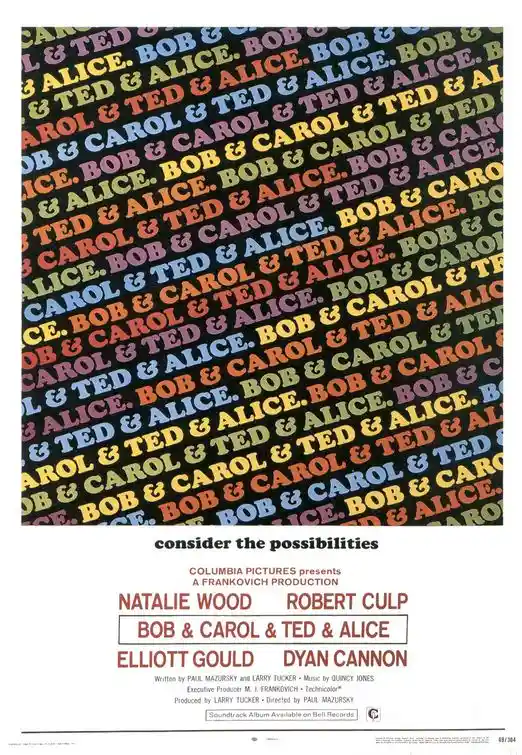
Bob & Carol & Ted & Alice (1969): The Satire That Loved Its Targets Too Much
Paul Mazursky's debut skewers Sixties sexual liberation while genuinely wrestling with its appeal. A comedy about open marriage that's secretly about the impossibility of honesty.
I watched Bob & Carol & Ted & Alice for the first time expecting a relic—one of those late-Sixties “groovy” comedies where everyone talks about free love and smokes pot while jazz flute plays on the soundtrack. The kind of film that feels desperate to be hip, that’s aged into unintentional parody.
I was wrong. Paul Mazursky’s 1969 debut is sharp, uncomfortable, and weirdly prescient. Yes, it’s dated in some obvious ways. Yes, the fashions and vocabulary mark it immediately as its era. But the questions it asks—about honesty in relationships, about the gap between what we say we want and what we can handle, about bourgeois co-optation of radical ideas—those haven’t aged at all.
This is not a film that mocks the Sixties from a conservative distance. It’s a film that takes the era’s ideals seriously enough to show why they don’t work, at least not for these people, at least not yet.
The Setup: Enlightenment for Sale
Bob (Robert Culp) and Carol (Natalie Wood) are an attractive LA couple—he’s a documentary filmmaker, she’s beautiful and bored. They attend a weekend encounter session at what’s clearly based on Esalen Institute, the Big Sur retreat that was ground zero for the Human Potential Movement.
At Esalen (called “The Institute” in the film), they learn to share their feelings, touch strangers, cry openly, and pursue “authentic” emotional expression. They return to LA transformed—or so they believe. Bob confesses to an affair. Carol, following the new rules, accepts this without jealousy. She even thanks him for his honesty.
Their best friends Ted (Elliott Gould) and Alice (Dyan Cannon) are skeptical. Ted’s a lawyer; Alice is anxious. They’re “squares,” we’re meant to understand, trapped in conventional thinking. But as Bob and Carol proselytize their new freedom, Ted and Alice get drawn in. And things get complicated.
The Quartet: Four People Looking for Permission
What makes Bob & Carol special is that Mazursky doesn’t play favorites. Each character gets their humanity, their contradictions, their moments of both insight and self-deception.
Bob is the true believer—but watch Culp’s performance carefully. There’s a smugness to his enlightenment, a sense that he’s using the language of emotional authenticity to get what he wants (which is permission to have affairs without consequences). His “honesty” is selective. He confesses the affair but manipulates Carol’s response.
Carol is the enabler—but Natalie Wood gives her real depth. Carol isn’t stupid; she knows she’s being managed. But the alternative is what? Jealousy, divorce, the old script? She chooses to believe because the alternative is unbearable. Her acceptance isn’t liberation; it’s a different kind of trap.
Ted is the skeptic—Elliott Gould, wonderfully neurotic, playing a man who desperately wants to join the party but can’t quiet his doubts. His eventual affair isn’t about desire; it’s about not wanting to be left behind. He cheats because Bob cheated, because that’s the new normal, because he’s terrified of being the only one still playing by old rules.
Alice is the audience surrogate—Dyan Cannon, in an Oscar-nominated performance, gives us someone who keeps saying what we’re thinking. When Bob and Carol describe their breakthrough, Alice’s face cycles through confusion, politeness, and barely suppressed “are you kidding me?” She’s the least deceived person in the film, which is why she’s also the most anxious.
| Character | Claims to Want | Actually Wants |
|---|---|---|
| Bob | Emotional authenticity | Permission to cheat |
| Carol | True liberation | Bob’s approval |
| Ted | To be “normal” | To not feel left out |
| Alice | Stability | To not be the only sane one |
The Sex That Doesn’t Happen
⚠️ Spoiler Warning: Major plot discussion follows.
The film builds toward what seems inevitable: a four-way. After enough drinking, confessing, and boundary-pushing, the two couples end up in a Las Vegas hotel room, ostensibly ready to swap partners and consummate their liberation.
And then… they don’t.
The scene is extraordinary. Four naked people in a bed, finally confronting what their philosophizing has led to, and finding that they can’t go through with it. Not because they’re prudes—they’ve genuinely worked themselves up to this. But because the reality of actually touching someone else’s spouse, of watching your spouse touch someone else, turns out to be different from the theory.
The scene isn’t played as triumph of conventional morality over hippie hedonism. It’s more complicated than that. These four people genuinely love each other, genuinely believe in what they’ve been pursuing. But the body doesn’t follow the mind. Liberation turns out to be harder than deciding to be liberated.
They get dressed. They leave. They walk through the casino in silence. And then Mazursky does something remarkable: he has them join a crowd of other casino-goers, and everyone starts singing “What the World Needs Now Is Love.” It should be corny—it is corny—but it’s also strangely moving. These people tried something. It didn’t work. They’re walking back into the world uncertain about everything except that they care about each other.
Mazursky’s Compassionate Satire
Paul Mazursky was himself a product of the counterculture—an improvisational actor, a bohemian, someone who’d been to Esalen and done the encounter groups. He wasn’t making fun of the movement from the outside. He was interrogating it from within.
This matters. When the film laughs at Bob and Carol’s jargon—all the talk of “openness” and “authenticity” and “getting in touch with feelings”—it’s not the laughter of dismissal. It’s the laughter of recognition. Mazursky knows how seductive this language is, how much people want it to be true. The satire works because the satirist was a believer who learned better.
Compare this to how other films from the era treated the counterculture:
- I Love You, Alice B. Toklas (1968): Hippies as cute, harmless aliens
- Easy Rider (1969): Counterculture as martyred saints
- Beyond the Valley of the Dolls (1970): Counterculture as Gothic nightmare
Bob & Carol threads a needle none of these films attempt. It shows the appeal of sexual liberation and emotional authenticity without pretending that appeal is false. It shows the failures without declaring the project hopeless. It’s a film about people who want to be better than they are, which is to say it’s a film about everyone.
The BFI’s Reading: “Rich, White, and Privileged”
The British Film Institute’s programming notes for Bob & Carol offer a sharper critique than Mazursky himself might embrace. They describe the film as showing “rich, white, and privileged adults who fancy themselves liberated because they found an excuse to cheat.”
This isn’t wrong. Bob and Carol live in a beautiful house. They can afford weekend retreats. Their “liberation” costs money, requires leisure, presupposes material security. When Bob confesses his affair, neither he nor Carol has to worry about economic consequences. Their experimentation is underwritten by privilege.
But I think Mazursky knows this. The film’s setting in wealthy LA isn’t accidental. These are people insulated enough from real struggle that they can afford to manufacture emotional crises. Their search for authenticity is partly a search for any feeling at all in lives padded by comfort.
This isn’t a defense—it’s an observation. The film doesn’t celebrate these people; it observes them with a kind of appalled tenderness.
Technical Notes
For a comedy about relationships, Bob & Carol is visually sophisticated:
The opening sequence at The Institute is shot in handheld, documentary style—grainy, immediate, verité. This marks it as “real,” as authentic, in contrast to the controlled Hollywood glamour of the rest of the film.
The hotel room scene is a single extended take, letting the awkwardness build in real time. No escape cuts, no relief. We’re trapped in there with them.
The final casino walk shifts into slow motion as the Bacharach song plays. Time suspends. The film becomes something like a dream—or a question left hanging.
Charles Lang’s cinematography earned an Oscar nomination, and it’s deserved. This is a visually thoughtful film that uses style to advance theme.
The Performances: Four Actors at Their Peak
All four leads were nominated for (or should have been nominated for) acting awards:
Robert Culp was primarily a TV actor, but here he brings genuine movie-star presence while also letting us see through his character’s charm. His Bob is both appealing and insufferable—no easy trick.
Natalie Wood was transitioning from ingenue to adult actress, and Carol is maybe her best mature role. She finds the intelligence in a part that could have been pure doormat.
Elliott Gould was about to become one of the defining actors of the New Hollywood. His Ted is a bundle of anxieties, likeable despite himself, desperate to belong.
Dyan Cannon got the Oscar nomination, and her Alice is the film’s secret weapon—the voice of doubt that keeps the audience grounded. Her therapy scene, where she tries to explain why she’s upset about Bob’s affair even though Carol isn’t, is comedy and tragedy in equal measure.
Cultural Moment
Bob & Carol & Ted & Alice was the sixth-highest-grossing film of 1969, beaten only by Butch Cassidy, The Love Bug, Midnight Cowboy, Easy Rider, and Hello, Dolly!. Four Oscar nominations. Major cultural talking point.
The film worked commercially because it let mainstream audiences feel like they were confronting taboo subjects while reassuring them that traditional values would ultimately prevail. The four-way doesn’t happen! Marriage survives! You can look at the counterculture without joining it!
But that’s a cynical reading. Mazursky wasn’t simply providing comfort. He was acknowledging something real: that most people, when it comes down to it, aren’t ready for the revolutions they claim to want. That’s not a conservative position. It’s just an honest one.
Why It Matters Now
In an era of ethical non-monogamy discourse, relationship anarchy, and a thousand think-pieces about “opening up,” Bob & Carol feels startlingly relevant. The conversations these characters have in 1969—about jealousy as a social construct, about honesty as the highest value, about the gap between ideals and emotions—are the same conversations happening on podcasts and in therapy sessions right now.
The film doesn’t offer answers. It offers observation. Here are people trying something. Here’s how it actually goes. Make of it what you will.
My Rating: 8/10
What works:
- All four performances are excellent
- Genuinely funny while also genuinely thoughtful
- The four-way-that-doesn’t-happen is brilliantly written
- Mazursky’s compassion for his characters
- More complex than it needed to be
What doesn’t:
- Some period-specific references are lost on modern audiences
- The pacing drags in the second act
- The Esalen scenes might feel clichéd to viewers familiar with the genre
- The ending is ambiguous in a way some will find unsatisfying
If You Liked This, Try:
- An Unmarried Woman (1978) — Mazursky’s later, more serious relationship study
- Shampoo (1975) — Hal Ashby’s darker take on LA’s sexual mores
- Carnal Knowledge (1971) — Mike Nichols’s brutal examination of male sexuality
- The Ice Storm (1997) — Ang Lee revisiting similar territory with decades’ distance
- Force Majeure (2014) — Another film about a couple whose self-image doesn’t survive a crisis
Bob & Carol & Ted & Alice holds up because it refuses easy positions. It’s not pro-free-love or anti-free-love. It’s pro-honesty, and honesty means admitting that we don’t always know what we want, that our ideals and our emotions don’t always align, that liberation might be harder than signing up for a weekend seminar.
Fifty-five years later, we’re still having the same conversations. We’re still learning the same lessons. And we’re still, most of us, walking out of hotel rooms before anything really happens, singing sentimental songs about love while trying to figure out what that word even means.
What the world needs now is love, sweet love. But what is love? The film doesn’t say. It just shows four people trying to figure it out, and failing, and trying again.
References
- Mazursky, Paul. Show Me the Magic, Simon & Schuster, 1999
- Kael, Pauline. “Bob & Carol & Ted & Alice” review, The New Yorker, 1969
- “Bob & Carol & Ted & Alice: BFI Southbank Programme Notes,” British Film Institute, 2021
- “‘Bob & Carol & Ted & Alice’ saw the Swinging ’60s as they were,” Vanya Land, 2019
- “Bob & Carol & Ted & Alice Considered Free Love Before the Age of Ethical Non-Monogamy,” Washington City Paper, 2023
- Anderson, John. “The Mazursky Touch,” Wall Street Journal, 2014