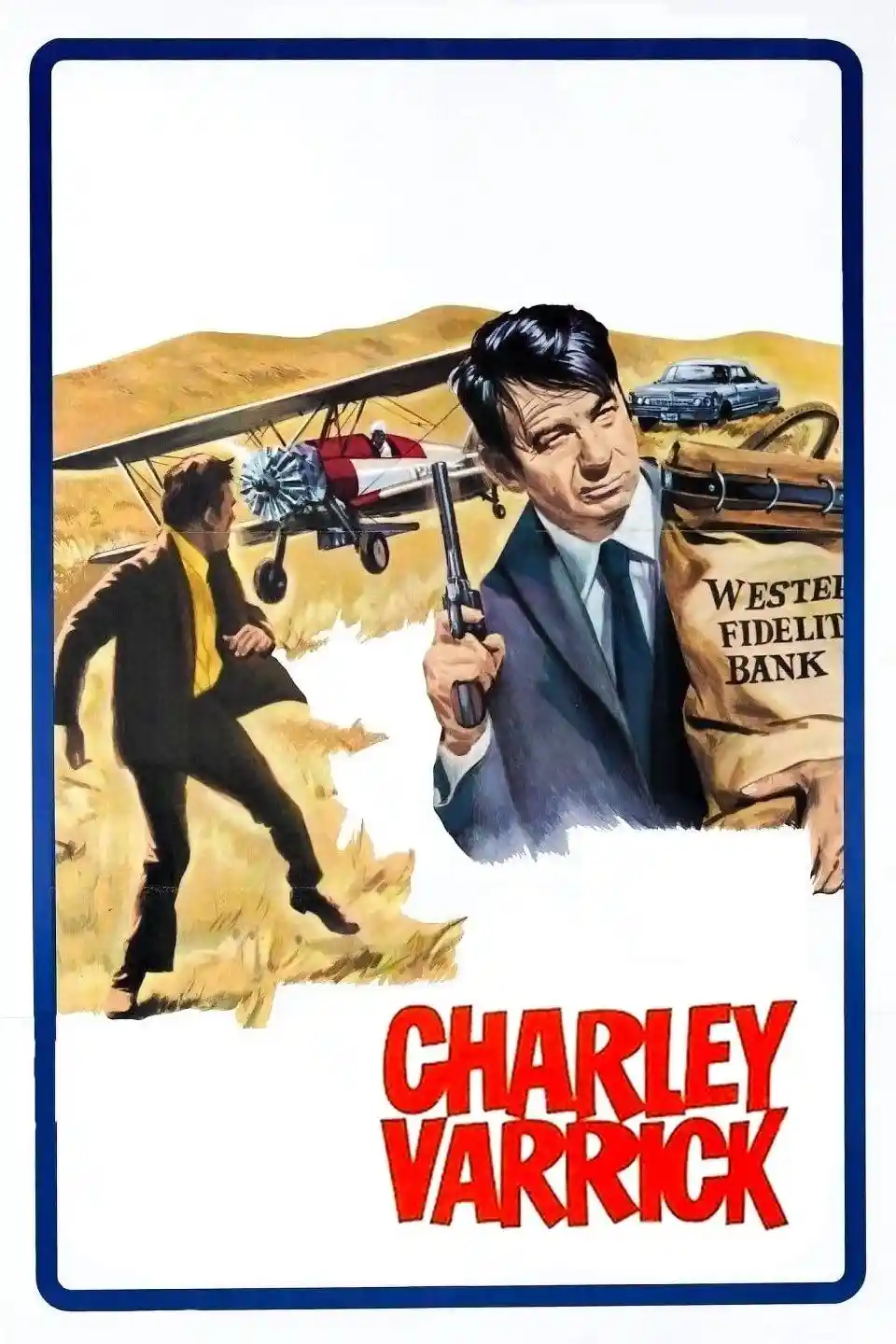
Charley Varrick (1973): The Working-Class Heist Film That Outsmarts Everyone
Don Siegel and Walter Matthau created the most intelligent heist film of the 1970s. A crop-duster who accidentally robs the mob shows how to think three steps ahead—and why it might not matter.
There’s a moment in Charley Varrick when our hero realizes he hasn’t robbed a bank—he’s robbed the mob’s bank. The take is over $750,000, far more than a small-town savings and loan should have. Anyone else would panic. Charley Varrick does something else entirely: he thinks.
Don Siegel’s 1973 heist film is one of the smartest crime movies ever made, and I don’t mean that as vague praise. I mean that its protagonist solves problems the way an engineer solves problems: methodically, practically, without ego. In a genre dominated by flashy scores and charismatic crews, Charley Varrick offers something rarer: competence as drama.
The Setup: A Simple Job Goes Wrong
Charley Varrick (Walter Matthau) is a former stunt pilot who now dusts crops in New Mexico—when he’s not robbing small-town banks with his wife (Jacqueline Scott) and young partner Harman (Andrew Robinson). The jobs are small. The take is modest. It’s blue-collar crime.
The opening heist goes sideways immediately. Charley’s wife is killed. Harman is wounded. But they escape with the money—and then Charley counts it.
$765,000.
No small-town bank has that much cash. This is dirty money. Mob money. Money that will be missed.
The Thinking Man’s Criminal
What separates Charley from every other movie criminal is his response to disaster. He doesn’t rage. He doesn’t flee. He sits down and figures out what’s happening.
| Problem | Charley’s Analysis | Solution |
|---|---|---|
| Too much money | Must be mob-connected | Can’t spend it locally |
| Mob will investigate | Need to disappear | But first, need to misdirect |
| Partner wants to spend | Will draw attention | Must manage Harman |
| Can’t run forever | Need permanent solution | Set up an ending |
Charley approaches crime like a systems engineer. He identifies the players: Boyle (John Vernon), the local mob front man; Molly (Joe Don Baker), the terrifying enforcer sent to recover the money. He maps out their likely moves. Then he creates a plan that accounts for what they’ll do at every step.
This is heist cinema as chess match, not action spectacle.
Walter Matthau: Not The Guy You’d Expect
Casting Matthau—then known primarily for comedies like The Odd Couple—as a criminal mastermind was inspired. He doesn’t look the part. He’s rumpled, middle-aged, soft around the edges. When he introduces himself as “Charley Varrick: Last of the Independents,” it sounds like a sad joke.
But that’s the trick. Charley survives because no one takes him seriously until it’s too late. His weapon is being underestimated. He’s not a tough guy or a charmer—he’s a working man who happens to be smarter than everyone else in the room.
Matthau plays this with zero movie-star ego. There are no quips, no cool moments, no opportunities for the audience to admire him. There’s just a man doing calculations in his head, staying three moves ahead.
Joe Don Baker: The Unstoppable Force
Against Charley’s intelligence, Siegel places Molly—Joe Don Baker’s most terrifying performance. Molly is a mob enforcer who operates by simple principles: find the money, kill everyone who touched it.
Baker plays him as genuinely unnerving. Molly smiles while threatening people. He’s polite. He’ll buy you a drink before he kills you. There’s a serenity to his violence that suggests he’s found his calling.
The film’s tension comes from watching these two approaches—Charley’s planning versus Molly’s inevitability—move toward collision. We know they’ll meet. We don’t know if thinking can defeat brutality.
The Ending: Earned Victory
⚠️ Spoiler Warning: Full discussion of the ending follows.
Charley Varrick ends with one of the most satisfying climaxes in heist movie history, and it earns every moment of it.
Charley has spent the film setting up what appears to be an escape by plane—his old crop-duster skills becoming relevant. Molly catches him at the airfield. It looks like our hero is done.
But Charley has planned for this. The plane he’s supposedly escaping in is rigged to explode. Molly, following his simple logic (kill everyone involved), kills Charley’s partner and takes his place on the plane. Charley watches from hiding as his enemy flies into the trap.
Then Charley drives away. No triumph, no celebration. Just a man who solved a problem and survived.
What makes this ending work is that it’s been set up throughout the film. Charley’s planning isn’t pulled from nowhere—we’ve watched him think at every step. The victory feels earned because we’ve seen the work.
Don Siegel: The Craftsman’s Craftsman
Siegel was one of Hollywood’s great professionals—not an auteur in the flashy sense, but a director who told stories with clarity and efficiency. His films (Dirty Harry, Escape from Alcatraz, Invasion of the Body Snatchers) work because they never waste a scene.
In Charley Varrick, his direction is almost invisible. The camera is where it needs to be. The editing is clean. The New Mexico locations look like real places, not movie sets. Everything serves the story.
This is the opposite of style-over-substance filmmaking. Siegel trusts his script and his actors. His job is to stay out of the way—which is harder than it looks.
The Blue-Collar Crime Film
Charley Varrick belongs to a subgenre I love: crime films about working people. Charley isn’t a genius pulling off elaborate scores. He’s a crop-duster who supplements his income with small-time robbery because that’s what’s available.
The film respects this world. The banks are real banks. The getaway cars are ordinary sedans. The motels are the kind where you pay cash and nobody asks questions. There’s no glamour to crime here—just survival.
This grounds the film in a way that more stylized heist movies can’t achieve. We believe in Charley because we believe in his world.
My Rating: 9/10
What works:
- Matthau’s against-type performance
- Joe Don Baker’s terrifying enforcer
- Intelligence as the driver of tension
- The ending pays off beautifully
- Siegel’s invisible, perfect direction
What doesn’t:
- Some may find the pace methodical
- Andrew Robinson’s partner is less developed
- The wife’s death is functional, not emotional
If You Liked This, Try:
- The Friends of Eddie Coyle (1973) — Another blue-collar crime masterpiece
- Point Blank (1967) — Boorman’s stylized take on criminal persistence
- The Driver (1978) — Another minimalist, intelligent crime film
- Thief (1981) — Michael Mann’s debut, similar working-man energy
- A Simple Plan (1998) — What happens when ordinary people find mob money
Charley Varrick deserves to be mentioned alongside the great heist films, but it rarely is. Maybe because it’s too quiet. Too smart. Too unwilling to give the audience the usual pleasures.
Charley Varrick, Last of the Independents, survives by thinking when everyone else reacts. In a genre built on flash and spectacle, that’s almost revolutionary.
Use your head. It’s the only weapon that matters.
References
- Siegel, Don. A Siegel Film (autobiography), Faber & Faber, 1993
- Muller, Eddie. “Charley Varrick introduction,” TCM Noir Alley
- Variety staff. Original review, 1973
- Canby, Vincent. “Charley Varrick review,” New York Times, 1973
- Reeves, John Howard. The Last of the Independents (source novel), 1971