Dust Bunny: Why Bryan Fuller's Maximalist Thriller Demands the Big Screen
With its obsessive production design, 3:1 aspect ratio, and Art Nouveau fever dream aesthetics, Dust Bunny is the rare action film that doubles as a masterclass in visual storytelling. Here's why you need to see it in theaters.
Some films you can watch on your phone. Some films deserve a television. And then there’s Dust Bunny—a movie that demands the largest screen you can find, preferably in a darkened theater where its maximalist visual assault can properly overwhelm your senses.
Bryan Fuller’s theatrical debut is many things: a surreal fairy tale, an 80s homage, a psychological thriller, a showcase for production design that borders on the obsessive. What it is not, under any circumstances, is a movie that translates to small screens.
Go see it in theaters. You’ll thank me later.
The Premise: Childhood Fears Made Flesh
The setup sounds deceptively simple. A young girl must confront the monsters she’s imagined—or perhaps not imagined—in a world where the boundaries between reality, dream, and psychological unease have completely dissolved.
If that sounds like every dark fairy tale ever made, you’re not wrong. But Fuller takes this familiar framework and pushes it through a visual processor that transforms everything into something genuinely unprecedented.
Sophie Slang plays our protagonist with a combination of vulnerability and steel that recalls the great child performances of 80s genre cinema. She’s not a passive victim waiting for rescue; she solves her own problems, confronts her own fears, exhibits her own agency. Fuller explicitly cites the Amblin productions of that era as inspiration—those films where kids were heroes rather than plot devices.
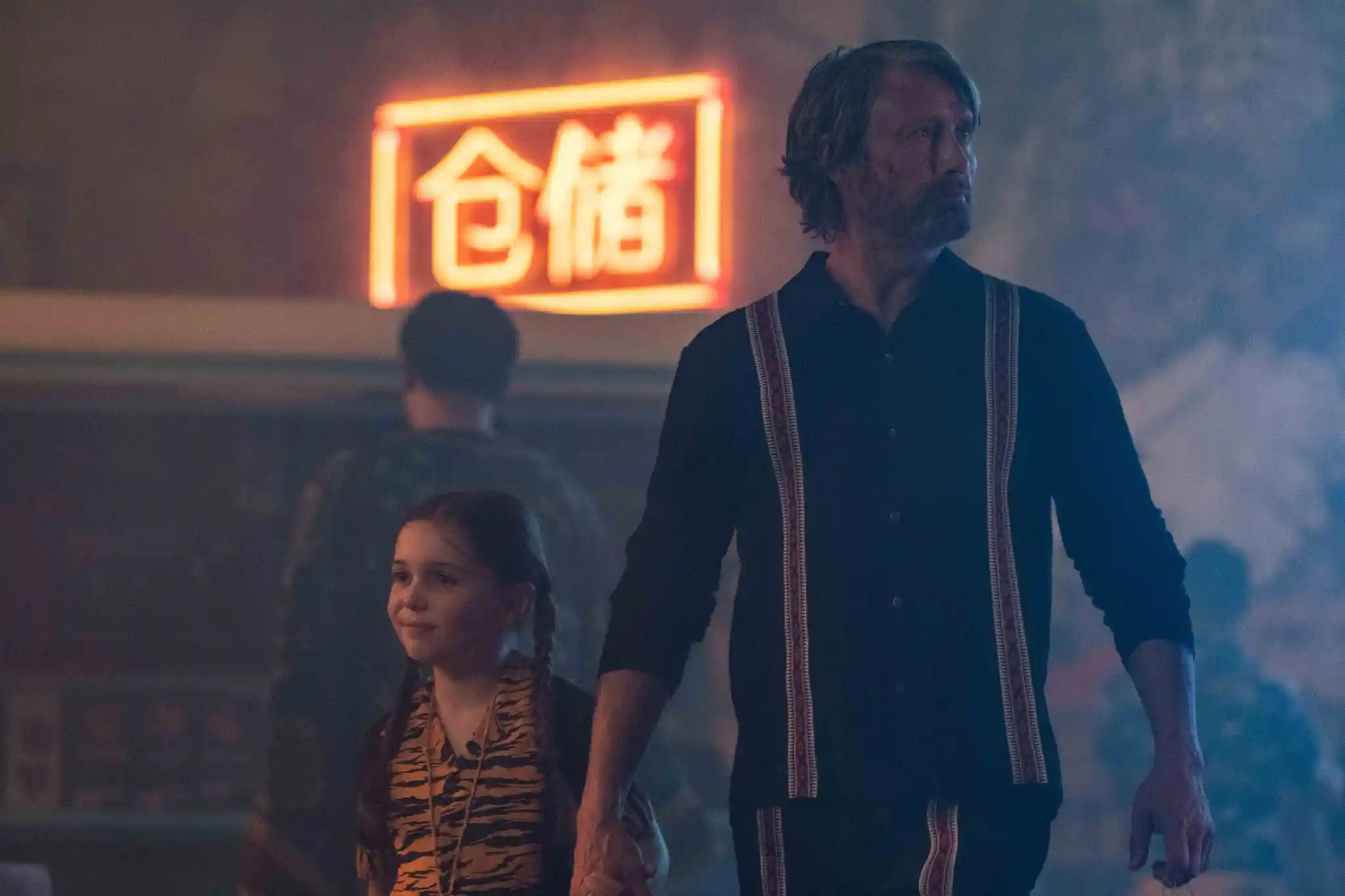
Mads Mikkelsen does what Mads Mikkelsen does: transforms what could be a generic antagonist role into something layered, unsettling, and weirdly sympathetic. His presence alone would be reason enough to see the film, but here it’s almost incidental to the larger visual experience.
The Aspect Ratio: A Frame That Isolates
Fuller shoots Dust Bunny in a 3:1 aspect ratio—an extremely wide format that creates images resembling horizontal slits carved into the screen.
This isn’t a gimmick. The ultra-wide frame serves the story’s themes of isolation and claustrophobia. Characters appear trapped within the frame, surrounded by negative space that seems to press in on them. When Fuller fills that space with his elaborate production design, the effect is overwhelming—like being inside a music box that’s slowly closing.
The format also demands theatrical presentation. On a phone or laptop, you’d lose roughly 60% of your screen to black bars. The compositions simply don’t work at that scale. This is cinema designed for cinema, unapologetically hostile to the streaming experience.
Production Design as Character
Let’s talk about the sets, because they’re the real stars of Dust Bunny.
Fuller collaborated with production designer Michael Wylie to create environments that function as externalized psychology. Every room tells a story. Every prop carries meaning. The maximalist approach piles detail upon detail until viewers find themselves pausing to absorb what they’re seeing—except the film doesn’t pause, forcing you to choose between following narrative and drinking in visuals.
The Art Nouveau influence is impossible to miss: organic curves, botanical motifs, ornate patterns that seem to grow from the architecture itself. But this isn’t period recreation. Fuller filters the aesthetic through a contemporary lens, creating spaces that feel simultaneously nostalgic and alien.
One sequence set in a child’s bedroom-turned-nightmare showcases the approach perfectly. Familiar objects—toys, books, wallpaper—have been subtly warped, proportions slightly wrong, colors slightly off. Nothing is explicitly frightening, but everything triggers unease. Your brain recognizes what it’s seeing while simultaneously rejecting it.
This is production design as psychological horror, and it’s masterfully executed.
The 80s Connection
Fuller has been open about Dust Bunny’s debt to 80s genre filmmaking, and the influences are visible throughout.
The Amblin comparison is most obvious. Like E.T., The Goonies, and Labyrinth, this is a film about a young person navigating a fantastical situation without adult intervention. The stakes are real, the dangers genuine, but the protagonist has agency and capability. It’s a model of children’s adventure that Hollywood largely abandoned and that Fuller resurrects with evident affection.
But there’s darker 80s DNA here too. The surreal horror of A Nightmare on Elm Street, the Gothic fairy-tale atmosphere of The Company of Wolves, the psychological complexity of Return to Oz—Fuller synthesizes these influences into something that honors its sources while feeling entirely contemporary.
The practical effects work reinforces the period connection. While CGI appears where necessary, Fuller prioritizes tangible elements: elaborate prosthetics, mechanical creatures, sets you could actually walk through. The result has weight and texture that purely digital creations rarely achieve.
Mads Being Mads
Every Mads Mikkelsen performance is a gift, and Dust Bunny is no exception.
His role requires him to be simultaneously threatening and tragic, a figure of childhood nightmare who gradually reveals depths you didn’t expect. Mikkelsen accomplishes this through his characteristic physical precision—the way he holds his body, the deliberate pace of his movements, the micro-expressions that communicate whole emotional histories.
There’s a scene midway through where his character explains his origins, and Mikkelsen delivers what could have been exposition as something closer to confession. You find yourself feeling sympathy for this monster, which makes his subsequent actions all the more disturbing.
The chemistry between Mikkelsen and young Sophie Slang drives the film’s emotional core. Their scenes together crackle with tension and unexpected tenderness, a predator-prey dynamic that keeps shifting until you’re no longer sure who’s hunting whom.
Sound Design and Score
While the visuals dominate discussion, Dust Bunny’s audio landscape deserves equal attention.
The sound design creates an environment where ordinary noises become threatening. Creaking floorboards, distant music, the ambient hum of an old house—these familiar sounds are mixed and processed until they trigger fight-or-flight responses. It’s subliminal filmmaking that works on your nervous system without your conscious awareness.
The score (by Fuller’s frequent collaborator) complements this approach with music that shifts between lullaby sweetness and discordant horror. Recurring motifs get twisted as the film progresses, childhood melodies becoming unrecognizable as they’re filtered through nightmare logic.
In a good theater, with proper sound, this becomes an immersive experience that headphones or TV speakers simply cannot replicate. Another reason to see it on the big screen.
Why Theatrical Matters
I’ve emphasized the theatrical experience because Dust Bunny is specifically designed for it—and because films like this are endangered.
The economics of modern cinema push toward streaming, toward content designed for distracted viewing, toward films that lose nothing on a small screen. Dust Bunny is a deliberate rejection of that trend. It demands attention, rewards focus, and delivers an experience that requires proper presentation.
Supporting it in theaters is a vote for a certain kind of filmmaking. It tells studios that audiences still want immersive visual experiences, that we haven’t surrendered entirely to the algorithm-optimized content pipeline.
But beyond industry politics, the simple truth is that you’ll enjoy Dust Bunny more in a theater than anywhere else. The film’s power depends on scale, on darkness, on the collective experience of audience response. Watching it at home would be like looking at photographs of fireworks—technically you’d see what happened, but you’d miss what it meant.
The Fuller Signature
Bryan Fuller made his reputation in television with shows like Hannibal, Pushing Daisies, and American Gods. Each demonstrated his signature aesthetic: dark material presented with visual beauty, grotesque imagery rendered gorgeous, tonal shifts between horror and whimsy that shouldn’t work but somehow do.
Dust Bunny translates this sensibility to the big screen with remarkable success. The feature format allows Fuller to sustain and develop his approach over two hours, building a world with more detail than television budgets typically permit.
Hannibal fans will recognize the meticulous framing, the attention to texture and color, the way violence becomes almost abstract through careful composition. But the film also ventures into territory the show couldn’t explore—a child’s perspective, a fairy-tale structure, a kind of innocence that Fuller’s previous work deliberately avoided.
It’s an evolution rather than a repetition, and it suggests Fuller’s film career might surpass his already impressive television achievements.
Should You See It?
Not everyone will love Dust Bunny. The pacing is deliberate, the narrative occasionally obscure, the visuals so overwhelming they can induce sensory fatigue. If you need constant action or explicit plot clarity, this may frustrate you.
But if you’re open to cinema as experience rather than just story—if you appreciate films that function as visual art—if you’ve ever wished mainstream movies would take more risks—Dust Bunny delivers.
It’s the kind of film that reminds you why movie theaters exist. In an era when the theatrical experience often feels redundant, Fuller has made something that demands it.
Find the biggest screen in your area. Sit close enough that the image fills your vision. Let Dust Bunny do what it was designed to do.
You won’t experience anything else quite like it this year.
Should you see it? Absolutely yes—in theaters, on the biggest screen possible.
Best for: Fans of Bryan Fuller, production design enthusiasts, anyone who misses 80s dark fantasy
Skip if: You need fast pacing, clear explanations, or plan to watch on your phone
Similar films:
- Pan’s Labyrinth - Dark fairy tale with stunning visuals
- The Fall (2006) - Maximalist production design as storytelling
- Return to Oz - Darker, stranger children’s fantasy
- Crimson Peak - Gothic visual excess (also Mads-adjacent)